Walk into any gym and you’ll see two extremes. On one side: people grinding through sets with heavy weights for only 5 repetitions. On the other: people using light weights doing a lot of repetitions, often up to 20 or even 30. What is the best approach for your training, especially if you are a man or woman in your midlife?
LOADING RANGES: WHAT IS CONSIDERED ‘HEAVY’ AND WHAT IS CONSIDERED ‘LIGHT’ IN WEIGHT TRAINING?
Heavy weights typically means lifting around 80–90% of your one-repetition maximum (the maximum weight that you can lift one time with proper form). The sets are relatively short – with this weight you can usually do around 4-8 repetitions. Light weights fall roughly in the 50–60% range of your one-repetition maximum. Sets extend from 15 to 20 repetitions. The load is lower, but the duration of effort is longer. In the middle sits the moderate weight that you can typically lift for 8-12 repetitions per set.
WHAT DRIVES BETTER TRAINING RESULTS: LIFTING LIGHT WEIGHTS OR HEAVY WEIGHTS?
When you lift heavier weights, you place more force on the muscles, which induces high mechanical tension. When you lift lighter weights for more reps, you accumulate fatigue, which causes metabolic stress. Both training methods produce results, but their primary outcomes differ slightly. If you lift only very heavy weights, you will maximize your absolute strength. This happens because your nervous system becomes highly efficient at recruiting high-threshold muscle fibers. On the other hand, lifting lighter weights for more repetitions can trigger equal muscle growth (hypertrophy) to heavy weights, but your potential to build maximum strength will be limited.
What is important to understand is that training for strength and training for muscle growth are not mutually exclusive; you will always see benefits in both dimensions. Heavy weights put more emphasis on maximal strength, while lighter weights shift the focus toward muscular endurance alongside muscle building. However, there is one major caveat: the lighter the loads are, the closer you must train to failure. This means you must continue lifting until you can only produce another 1 or 2 repetitions with proper form.
IMPACT OF TRAINING WITH LIGHT OR HEAVY WEIGHTS ON JOINTS AND TENDONS
Heavy weights place higher absolute stress on your joints, tendons, and connective tissue. This stress is not inherently negative, it is exactly the stimulus that drives tissue adaptation and reinforcement. However, it demands a thorough warm-up and precise technique to execute safely. Light weights, on the other hand, reduce peak stress per repetition, making them highly accessible and safer for beginners or if you are on a recovery day. However, high-repetition training brings its own risk: as the repetition count climbs and fatigue gradually sets in, your execution form can easily degrade.
HOW YOU SHOULD APPLY LOADING RANGES IN MIDLIFE
As your body ages, it faces a natural decline in muscle mass (sarcopenia), hormonal and metabolic changes, a reduction in bone mineral density, and a loss of elasticity in tendons and connective tissues. To combat these physiological shifts effectively, you should embrace a smart, hybrid training model that leverages the unique benefits of both loading spectrums.
Heavy Weights
Heavy resistance training directly addresses the core problems of aging: It preserves and builds muscle mass, which is tightly linked to metabolic health and longevity. It maintains bone density, which is particularly important for women after menopause, where fracture risk increases significantly. Heavy strength training also improves hormonal responsiveness and directly counteracts many of the negative effects of hormonal changes in midlife (declining estrogen in women and testosterone in men). It also reinforces functional strength: the ability to lift objects, stabilize the body, and prevent falls. Most importantly, heavy training sends a clear signal to your body: this tissue is still required! Without that signal, the body reduces it. Light weights alone cannot produce this profound effect to the same degree. However, because the central nervous system, joints, and endocrine system do not recover as quickly in midlife, exclusively lifting heavy can lead to chronic joint inflammation, systemic fatigue, and acute injury.
Light Weights
To reduce injury risk and support adequate recovery, you should strategically integrate lighter weights into your routine. When you train with lighter loads for higher repetitions, you can accumulate the volume necessary for muscle hypertrophy without imposing high peak forces on vulnerable joints and tendons. The caveat for midlife lifters is that lighter sets must still be taken close to muscular failure to stimulate growth. Yet, very high-repetition sets can be highly fatiguing and may require longer recovery. Therefore, the smart midlife training concept uses a combination of both: heavy weights for low repetitions, and lighter weights for higher volume. This dual approach maximizes musculoskeletal resilience while respecting the body’s changing recovery boundaries.
SPECIAL TRAINING CONSIDERATIONS FOR WOMEN AND MEN IN MIDLIFE
Women
Women in midlife often under-train intensity, meaning they train with weights that are too light. There is a persistent cultural bias toward lighter weights and higher repetitions, often driven by the misconception that this is the way to “tone” the muscle. By focusing exclusively on high-rep, low-load training, women miss out on critical improvements to bone density, a factor that is even more vital for women in midlife than it is for men. Furthermore, true “muscle tone” is simply the passive tension in a muscle when it is not actively contracting. This look is achieved by developing dense muscle tissue and maintaining a lower body fat percentage. Training with heavy weights directly targets this muscle density. Crucially, women naturally tolerate higher volume and often recover faster between sets than men. Therefore, the optimal approach for women is not to abandon light weights, but to add heavy weight training to their routine.
Men
Men in midlife frequently display the exact opposite pattern: a strong tendency to over-prioritize heavy lifting at the expense of their joints. This approach dramatically increases the risk of joint irritation and chronic overuse injuries. In midlife, avoiding injury becomes the single most important factor for training consistency and progress. For men, the necessary adjustment is to retain their heavy intensity on a few select lifts while deliberately introducing more controlled, lighter work to balance joint stress and overall recovery.
RECOVERY AS THE LIMITING FACTOR
In midlife, recovery becomes your central training constraint. Heavy training places significant demands on your central nervous system and passive structures, while light training challenges muscular endurance, accumulating massive metabolic fatigue. Sustainable training is about applying the precise, optimal dose of stress that your body can successfully absorb, recover from, and repeat consistently over days, weeks, months and years.
PRACTICAL RECOMMENDATION: HOW TO PICK THE RIGHT WEIGHT FOR YOUR TRAINING
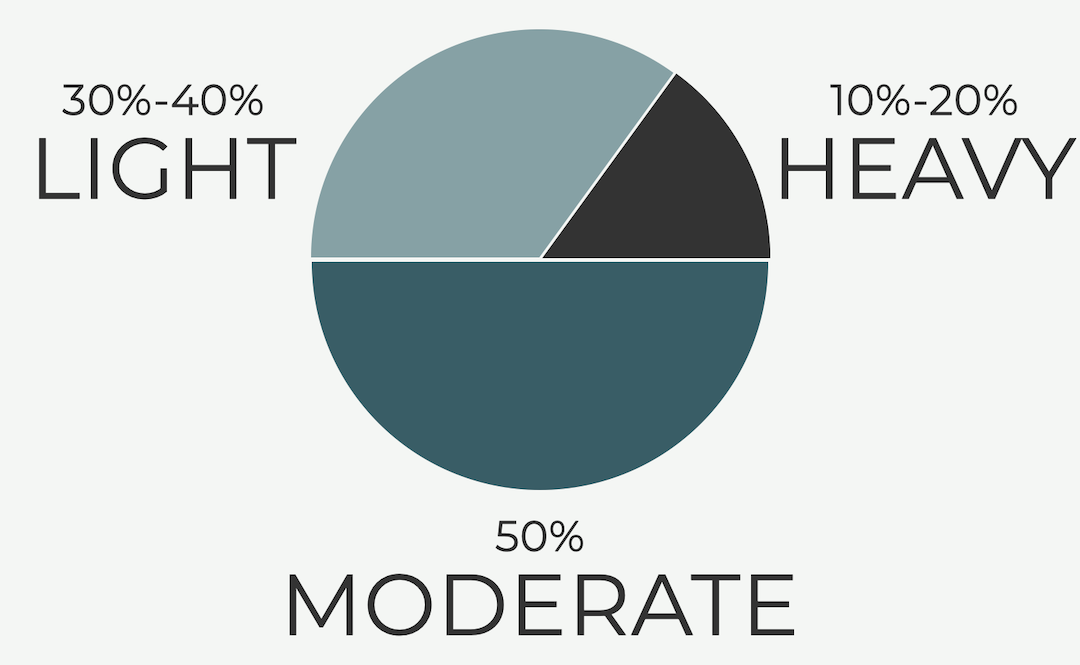
The question “heavy or light?” is entirely the wrong question. The correct question is: how do you distribute your training across a wide range of weights to produce the best long-term results? For men and women in midlife, shifting the majority of your training volume toward moderate loads while strategically using heavy and light weights offers the ultimate sweet spot between muscular stimulus and joint longevity and recover
As a practical starting point, many midlife lifters will benefit from structuring their training volume roughly as follows:
- 10-20% Heavy Loading (5–8 rep range): Reserved for a few select compound lifts to send the critical “tissue required” signal to your nervous system, bones, and tendons.
- 50% Moderate Loading (8–12 rep range): The majority of your routine, providing a balanced blend of mechanical tension and muscle building with a highly manageable recovery profile.
- 30-40% Light Loading (12–20 rep range): Used primarily for accessory and isolation movements to safely accumulate muscle volume, drive nutrient-rich blood flow, and protect your joints.